Linear rollout
Imagines the frame after each action and plans the next action from it.
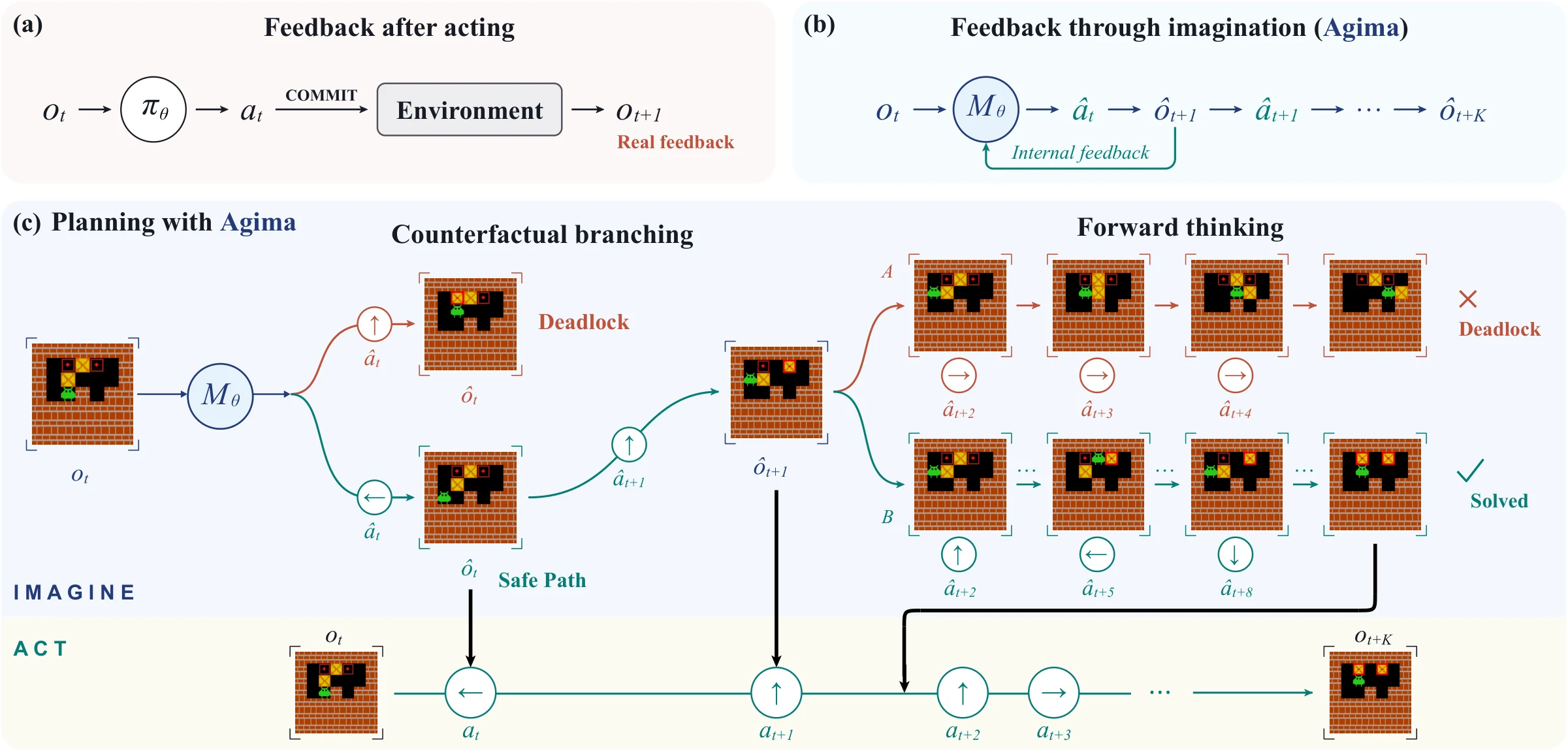
Agima (Agentic Imagination) trains an agent to imagine before it acts: a single omni model generates images of where its actions lead and plans over these imagined futures.
Agima generates actions and imagined frames in one sequence. Each imagined frame is the observation for the next action.
Figure 1. Planning with agentic imagination: (a) feedback after acting, (b) feedback through imagination with Agima, (c) counterfactual branching and forward thinking in Sokoban.
Imagines the frame after each action and plans the next action from it.
Imagines an alternative action and rejects it when its outcome fails.
Imagines complete candidate plans and commits to the one that succeeds.
We train Agima on the easy split of four environments and test it on a harder split it never sees in training.
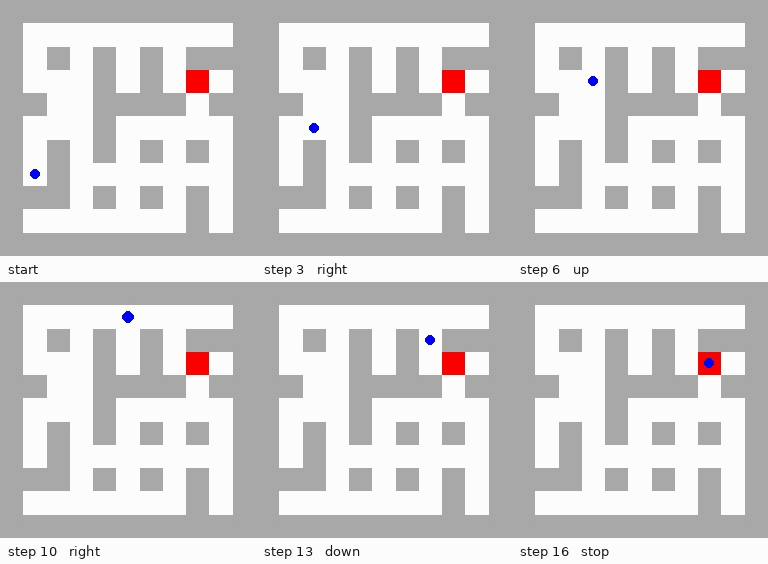
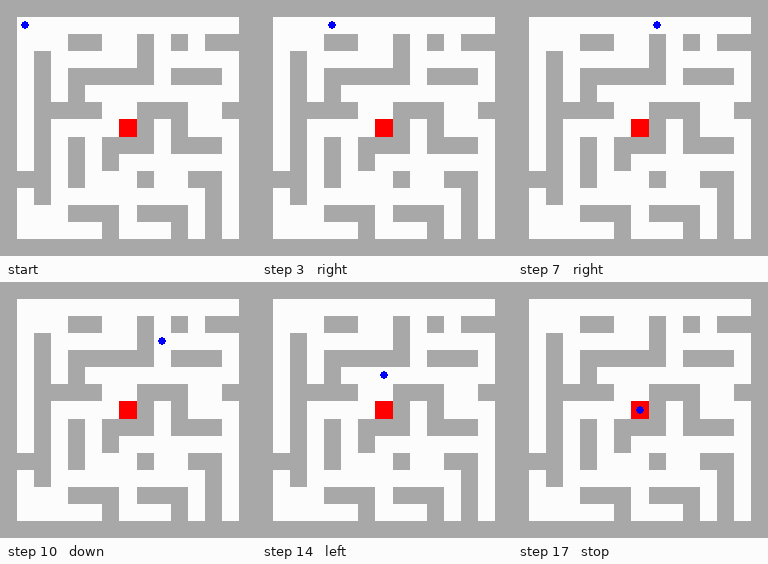
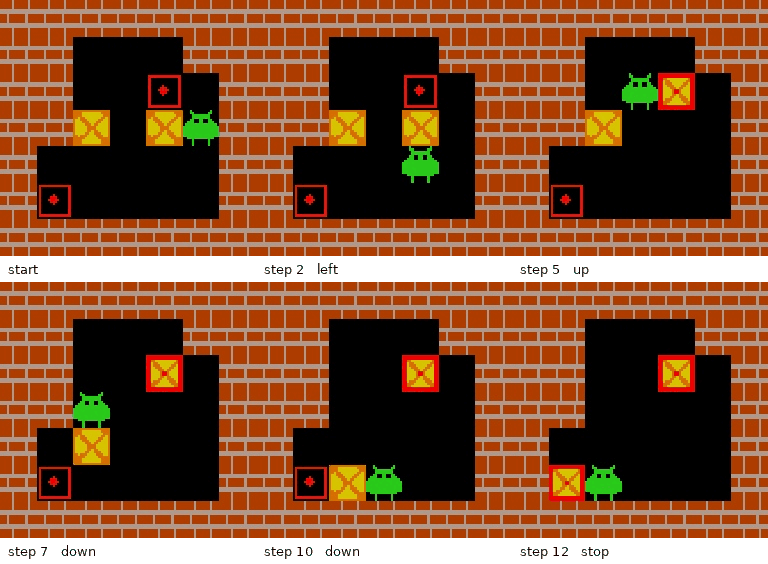
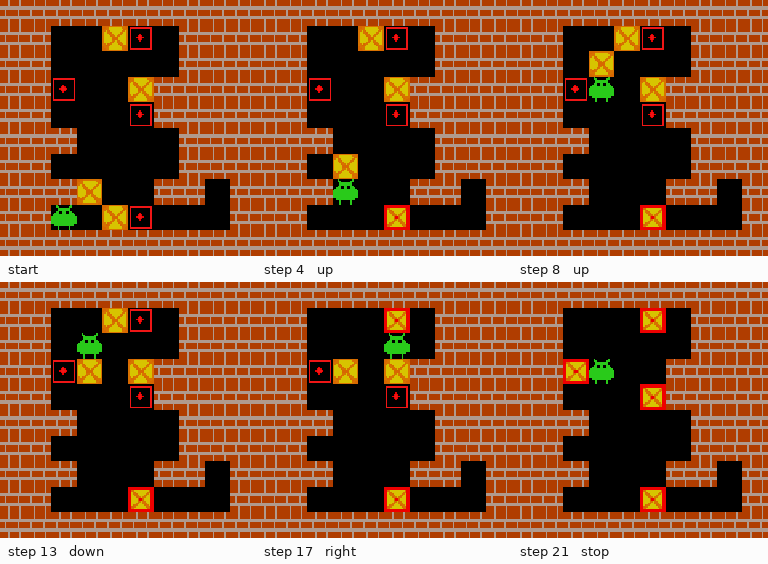
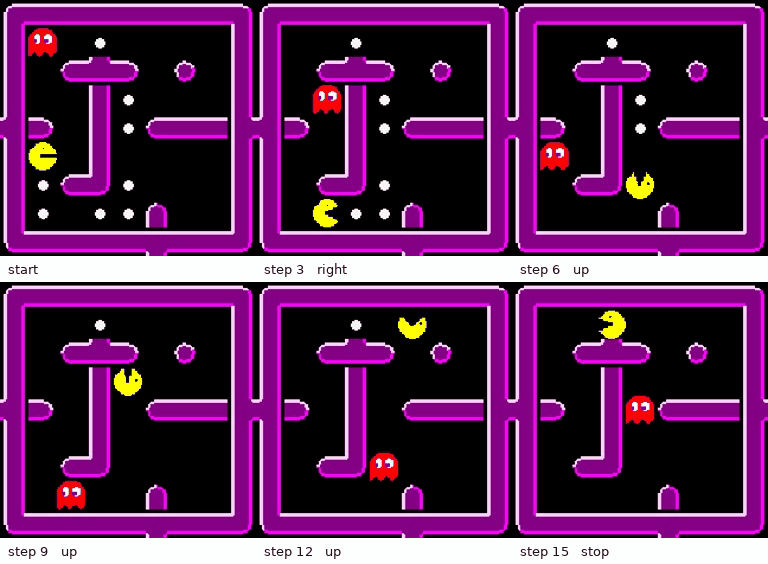
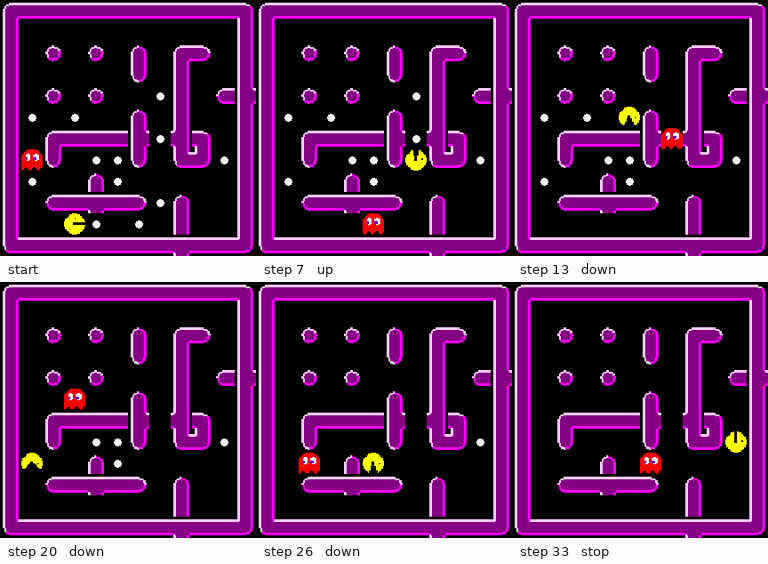
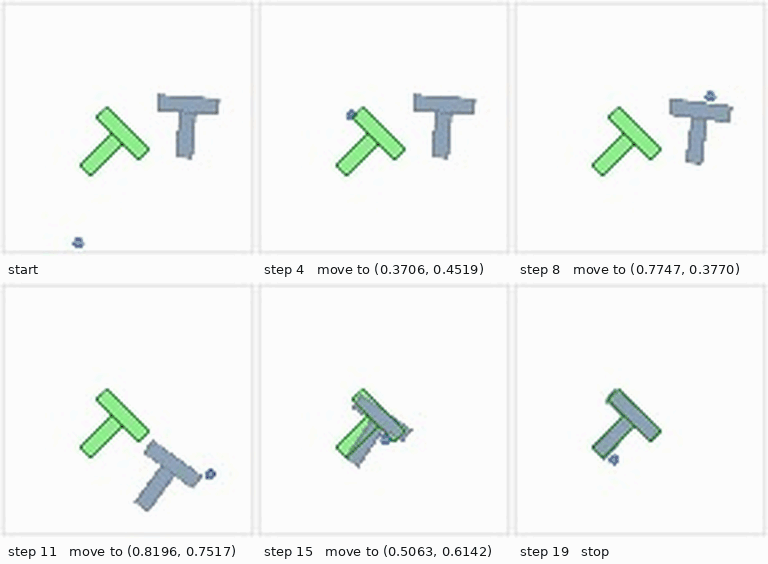
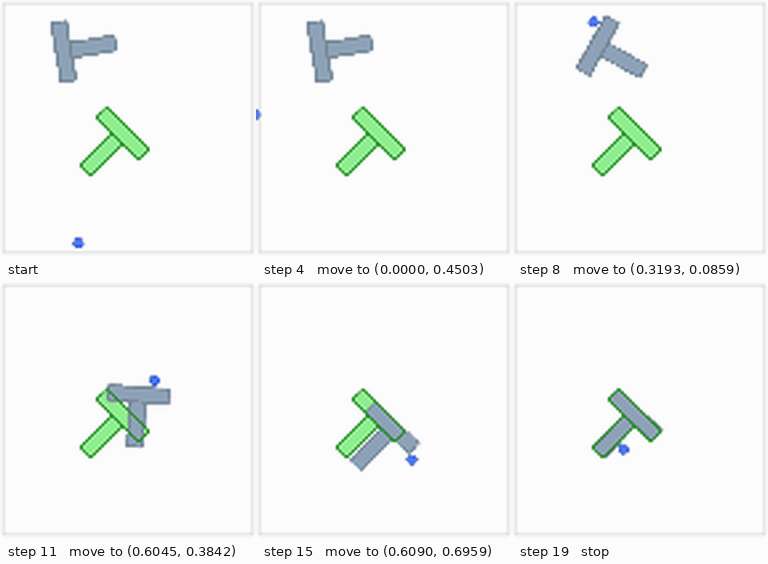
Figure 3. Ground-truth rollouts in each environment. The training split is on the left of each pair and the test split on the right.
K is the number of actions Agima executes per real observation. Between observations, it plans from its own imagined frames.
Test sets where a locally reasonable move fails several steps later. K = ∞.
One push puts the nearer box on the goal beside it. That goal is the only one the farther box can ever reach, so the farther box is left with nowhere to go.
A 2-box level from Agima's Sokoban generator. Test sets: 2, 3 and 4 boxes, 100 puzzles each.
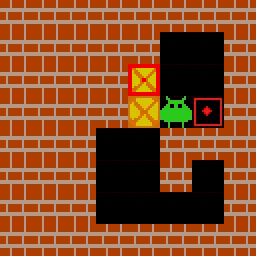
Farther box blocked
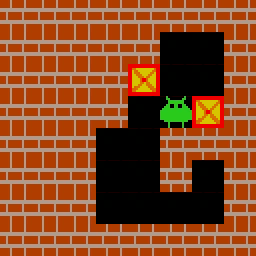
Solved in 18 moves
Two pushes are legal here. Pushing up pins a box to the wall in a row with no goal, and no later move brings it back. Pushing right keeps the puzzle solvable.
Test sets: 2, 3 and 4 boxes, 100 puzzles each.
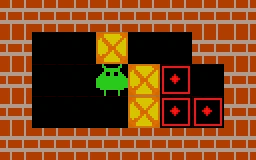
Box pinned to the wall
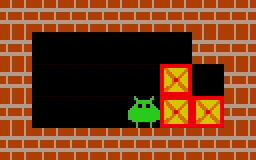
Solved in 13 moves
Going for the nearer food first leaves Pacman no escape from the ghost. Going for the farther food first clears the level.
The episode from Figure 3 of the paper. Test grids are 8×8 with 2, 4, 6 or 8 food, and 10×10 with 8.
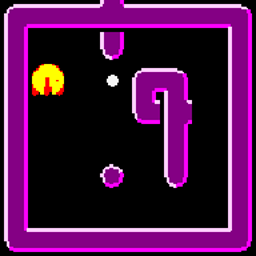
Caught by the ghost
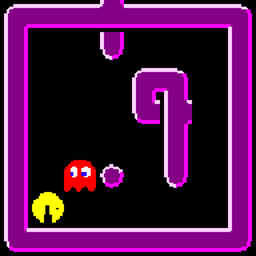
All food eaten
We run RL from the SFT models on three-box Sokoban, with a binary success reward and nothing else.


Every imagination variant improves, including on four-box puzzles it never sees in RL, while the action-only model stays near zero.
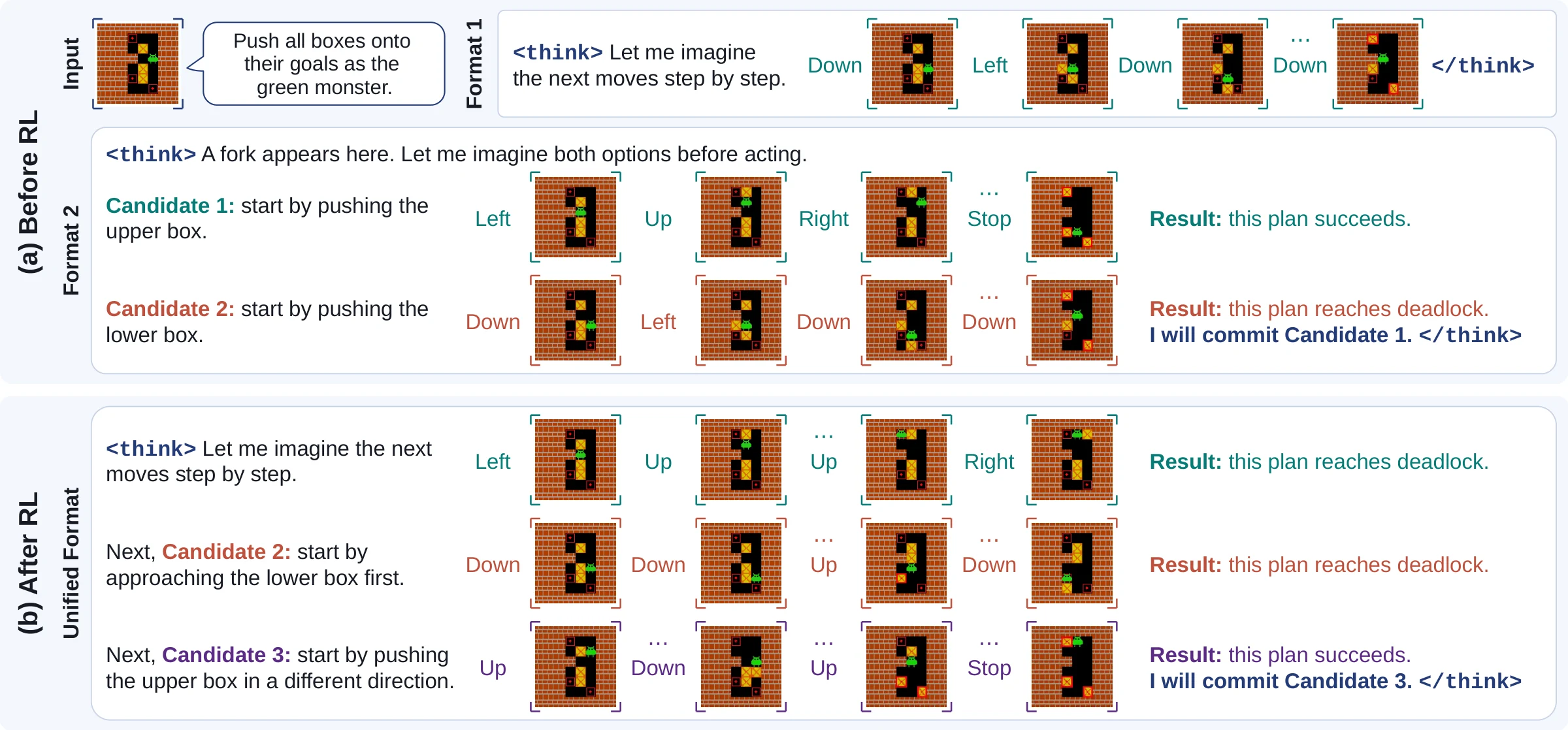
After RL, Agima rolls out one plan step by step and drafts the next only once it foresees a failure. Second plans drop from 79% to 26–31% of episodes.
 (opens the full-size image)
After RL, Agima branches more often, and more of its branches land where one push would make the puzzle unsolvable.
@article{agima2026,
  title   = {Training an Imaginative Agent},
  author  = {Ge, Jiaxin and Zhang, Junyi and Chai, Tianning and Yoo, Hanjun and Wang, Chenyang and Li, Xiuyu and Shi, Weijia and Wang, XuDong and Min, Sewon and Zettlemoyer, Luke and Darrell, Trevor and Feng, Haiwen},
  journal = {arXiv preprint},
  year    = {2026}
}